

Ready to join the adventure? Head over to the official https://pinup-turkey.top/game/pin-up-casino-aviator/ page and start playing today!
Pin Up Aviator is an innovative and fast-paced game where players can experience the thrill of high-stakes action. The objective is simple: cash out at the right moment before the plane flies away! Its unique mechanics and dynamic gameplay have made it a favorite choice for those seeking excitement and big wins.
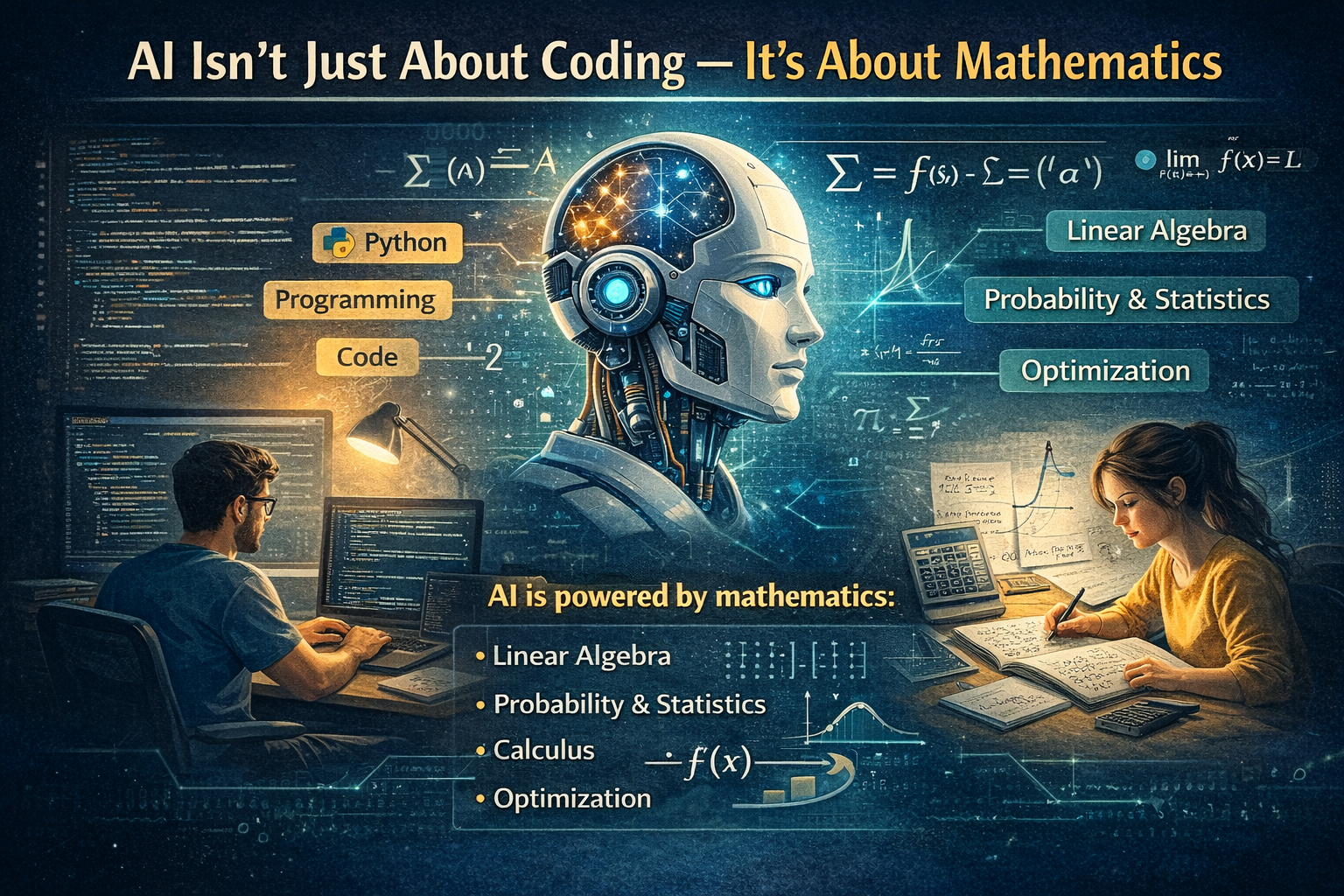
When people think about artificial intelligence (AI), they often imagine complex programming languages, endless lines of code, and advanced software development. While coding plays an important role in building AI systems, it is not the true foundation of artificial intelligence. At its core, AI is driven by mathematics. The algorithms, models, and systems that power modern AI are built upon mathematical principles long before they are translated into code.
Understanding this distinction is essential for anyone interested in working in AI. Programming is the tool—but mathematics is the engine.
The Real Foundation of AI
Artificial intelligence is fundamentally about teaching machines to recognize patterns, make predictions, and learn from data. These capabilities rely on mathematical frameworks such as:
- Linear algebra
- Probability theory
- Statistics
- Calculus
- Optimization techniques
Without these mathematical foundations, AI systems would not function effectively.
For example, machine learning models use linear algebra to handle large datasets and perform operations on matrices. Probability and statistics allow AI systems to make predictions under uncertainty. Calculus helps optimize models so they improve over time. In short, mathematics enables AI to “learn.”
Why Coding Alone Isn’t Enough
Many beginners assume that mastering programming languages like Python automatically prepares them for AI development. While coding is necessary to implement algorithms, it does not explain why those algorithms work.
You can write code that calls a machine learning library, but if you don’t understand the mathematical principles behind the model, you may struggle to:
- Tune model performance
- Diagnose errors
- Improve prediction accuracy
- Prevent overfitting
- Interpret results properly
AI is not just about running pre-built tools—it’s about understanding the logic behind them.
Mathematics Behind Machine Learning
Machine learning, one of the most important branches of AI, is deeply mathematical. Let’s look at how math supports it:
Linear Algebra
AI models often work with vectors and matrices. Neural networks rely heavily on matrix multiplication to process inputs and generate outputs.
Probability and Statistics
AI systems make predictions based on data patterns. Probability helps measure uncertainty, while statistics helps evaluate model accuracy.
Calculus
Training an AI model involves minimizing error. Calculus enables optimization techniques like gradient descent, which adjust model parameters to reduce mistakes.
Optimization
Optimization algorithms ensure AI models perform efficiently and accurately by finding the best possible solution among many options.
These mathematical tools are the backbone of AI innovation.
Neural Networks: A Mathematical System
Neural networks, inspired by the human brain, are a core component of modern AI systems. Despite their biological inspiration, they are entirely mathematical in structure.
Each layer of a neural network performs mathematical transformations on input data. These transformations are calculated using matrix operations and activation functions. The training process involves adjusting weights using derivatives—a concept from calculus.
Without mathematics, neural networks simply would not exist.
The Role of Coding in AI
While mathematics forms the foundation, coding is still essential. Programming languages allow developers to implement mathematical models into real-world applications.
Think of it this way:
- Mathematics designs the intelligence.
- Coding deploys it.
Programming frameworks like TensorFlow or PyTorch are tools that translate mathematical concepts into functioning AI systems. However, relying only on tools without understanding the math limits your ability to innovate.
Why Math Skills Matter for AI Careers
If you want to pursue a career in AI, strengthening your mathematical knowledge is a strategic advantage. Employers value candidates who can:
- Understand model behavior
- Analyze data critically
- Solve optimization problems
- Improve algorithm performance
- Interpret statistical results
Professionals who understand both coding and mathematics can design smarter systems, debug effectively, and contribute to research and innovation.
Can You Work in AI Without Advanced Math?
The level of math required depends on your role. Some AI-related positions focus more on implementation and application, where coding skills may be sufficient. However, roles involving research, model development, or algorithm design require a strong mathematical background.
Even for practical AI roles, a solid grasp of statistics and linear algebra significantly improves performance and understanding.
Building the Right Foundation
If you’re interested in AI but feel intimidated by mathematics, the good news is that you don’t need to master every advanced concept at once. Start with:
- Basic linear algebra
- Introductory probability
- Fundamental statistics
- Core calculus concepts
Many online resources and courses simplify these topics in an AI context, making them easier to understand.
The Future of AI and Mathematical Thinking
As AI continues to evolve, mathematical thinking will become even more important. Innovations in deep learning, reinforcement learning, and generative models are all grounded in advanced mathematical research.
Understanding math not only helps you work with AI tools—it empowers you to create new ones.
Conclusion
Artificial intelligence may appear to be a coding-heavy field, but beneath every AI system lies a framework of mathematical principles. Coding is the language that expresses AI models, but mathematics is what gives them intelligence.
If you truly want to excel in AI, don’t just focus on learning programming languages. Invest time in understanding the math behind the algorithms. Because in the world of artificial intelligence, code builds the structure—but mathematics builds the brain.
